There’s an element of futuristic romanticism involved when discussing virtual reality. The term is commonly associated with headset displays and data suits, while in my own mind I associate the term with using technology as a platform to cognitively take presence within a game, an idea that has been influenced by fiction. Virtual Reality is any technology which allows the user to interact with a simulated environment, which can reflect the real world or simulate an original space. I like to hold the fictional views in books I've read and movies I've watched as a prediction of what might one day come to fruition. The level of immersion related to a fully developed virtual reality system would only be surpassed by physically residing in the simulated environment. Sometimes it seems as though fiction can sometimes predict technologies before they are conceived, perhaps there is an element of inventors trying to accomplish feats from fiction, or maybe it takes a creative mind to conceptualise the currently irrational. I'm going to take a short detour from the path of my investigation to look at how veiws on VR were shaped by works of fiction.
While looking into definitions for Virtual Reality I came across Michael Heim's "The Metaphysics of Virtual Reality" in which he labels different concepts surrounding Virtual /reality including, simulation, interaction, artificiality, immersion, telepresence, full-body immersion, and network communication. A preveiw of the book can be viewed here.
Star Trek: The Holodeck
The holodeck was one of the first examples of Michael Heims "full-body immersion" I encountered when I was younger. An intelligent simulation projects holographic images into the room, which the users can interact with in a natural manner, using speech and touch as an interface with the simulation.
.hack//: The FMD interface
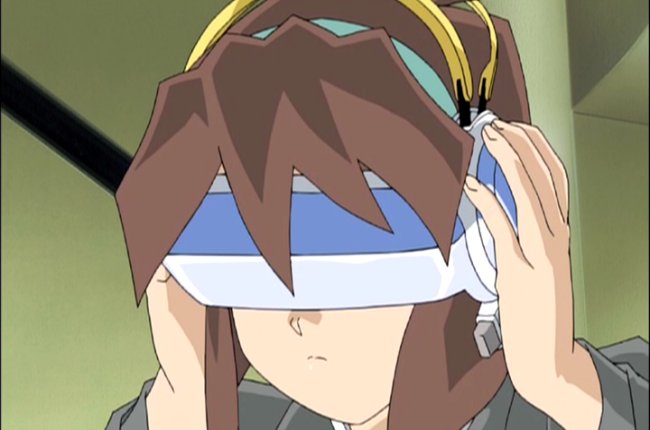 The FMD (face mounted display) is similar to the VR headsets we are used to seeing in current developement. ".hack//" is a multimedia franchise based around a fictional MMORPG which is so immersive that progressions in the story lead to players being indueced into comas. The anime suggests that the FMD immerses the players far more than a basic headset. One of the storys in .hack follows a girl who whilst playing realised she is no longer sitting at a terminal but is rather in the game itself. This sytem of VR doesnt give the full-body immersion that I relate to the holodeck but does give the players a level of telepresence within the game.
The Matrix

In this movie the "matrix" is a simulated world created by sentient computers in order to keep the humans dormant while they cultivate them for electricity. The sockets implanted on the humans load they're consciousnesses into the matrix programme, this gives them presence within the simulation and a full-body immersion within it, unfortunately for the people in the film, the matrix is so real to the brain that any damage your body suffers within the matrix, the brain thinks is real and can cause you damage in the real world.
I think it’s quite interesting when you look at what futuristic technology is thought up in fantasy and science fiction. My first two examples give pretty good reflections as to how immersive solutions companies are developing more immersive interfaces for digital environments. First the holodeck resembles the iCube in that its walls carry the images and create the display while the user stands within it, and the VR headsets seen in multiple movies have been a constant development since the Nintendo VirtualBoy. Although the technology itself has not come to fruition, works of fiction can almost challenge people to realise those ideas.
References:
http://en.wikipedia.org/wiki/Virtual_reality
http://en.wikipedia.org/wiki/Holodeck#cite_note-0
http://en.wikipedia.org/wiki/.hack
Michael Heim's "The Metaphysics of Virtual Reality"Toward the Holodeck: Integrating Graphics, Sound,
Character and Story
Interactive Storytelling in Virtual
Environments: Building the “Holodeck”


No comments:
Post a Comment